 Plant As Deco
Small Room Decor
Home Office Ideas for Small Spaces: A Renter's Guide
By Plant As Deco · Updated 17 November 2026
A home office in a small apartment is not a missing room — it is a corner you have not measured yet. Most setups fail the same way: the desk is too wide for the wall, the chair eats the walkway, and the cables run along the baseboard like a trip line. This plan starts from the space you actually have, not the office you saw in a photo. Work out the footprint, pick the spot, size the desk and chair, keep the storage off the floor, tame the cables, and set the light for long sessions. That is the whole job, and it fits a weekend with no drill.
Weekend-ready: $80–$220, one weekend. No drill, no wall work — renter-safe throughout.
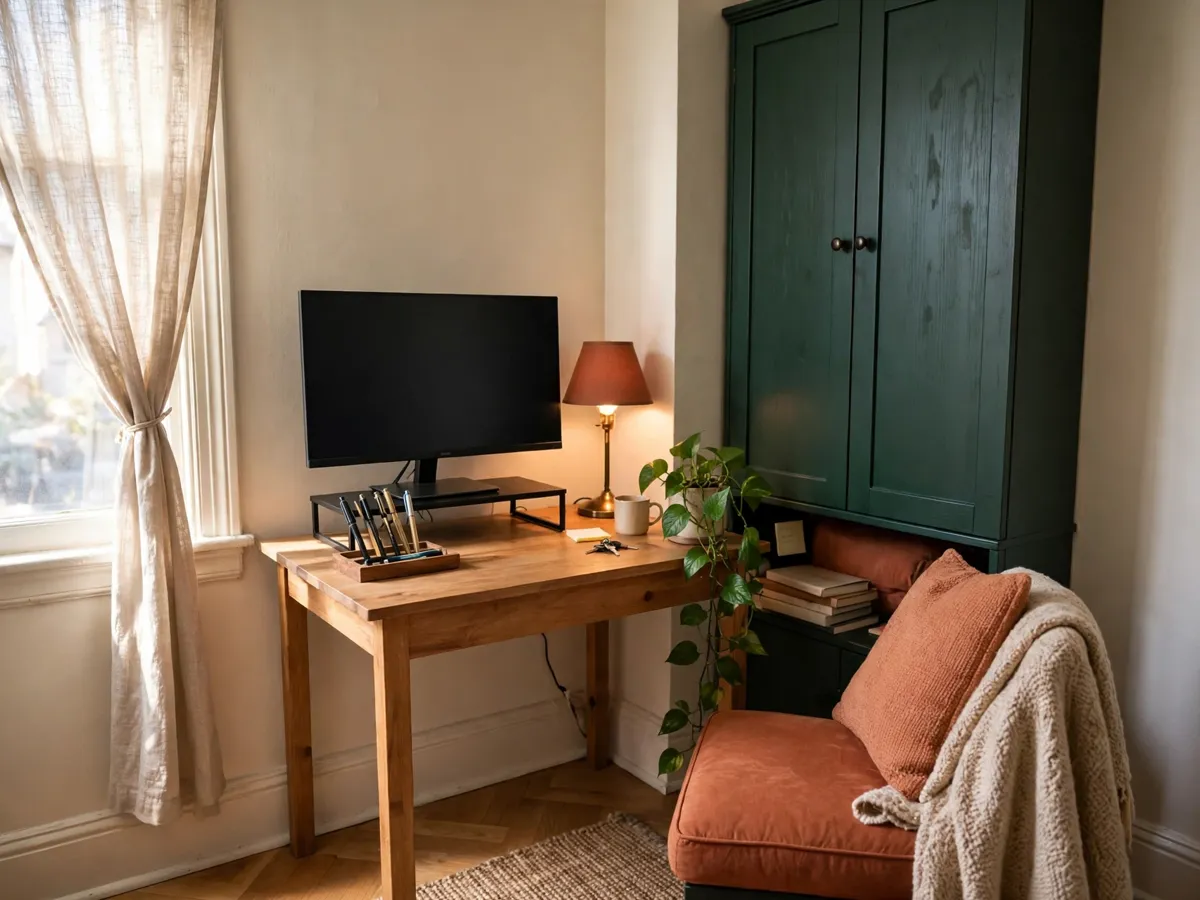
Start with the footprint, not the furniture
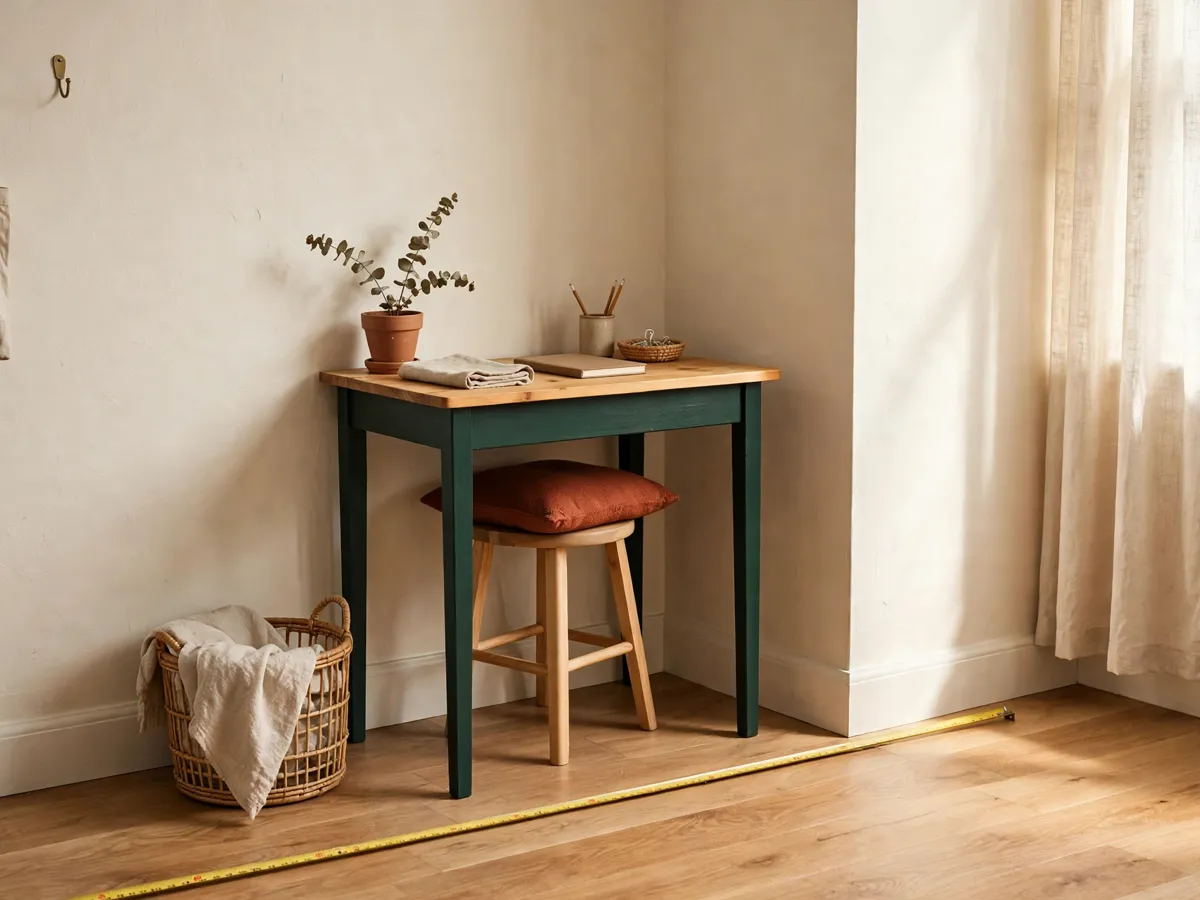
Before you look at a single desk, you need one number: how much floor a work corner actually eats. A compact 48 by 24 inch desk needs the desk, the chair pull-out, and the path you still walk to get past it. Add them up and the number is bigger than the desk, which is why a room that fits a desk on paper still feels tight.
Use this math as your starting point. A standard depth of 24 inches, a chair that pulls back 30 inches, and a clear path of at least 30 inches across the room. That puts a work corner at about 60 to 84 inches of wall to floor once the chair is out. Measure your wall, subtract a few inches each side for breathing room, and only then pick a desk that fits the leftover, not the dream size.
If the wall is shorter than that, the answer is not a bigger desk — it is a wall-mounted drop-leaf or a narrow 30 by 20 inch table that folds flat, and a stool instead of a full chair. The footprint shrinks by half and the room stays walkable.
Cost: $0 to measure. Time: 20 minutes with a tape measure and the room cleared.
Pick the spot that earns its space
The spot does more work than the furniture. Choose it for light and quiet, and the office will hold up; choose it for leftover space and you will be moving the chair every hour. A wall with a window beats a dark far corner, because the light is free and it keeps the screen out of direct sun, which is the one thing that ruins a photo call.
| Spot | What you get | Watch for |
|---|---|---|
| Window wall | Free daylight, screen out of direct sun | Glare on the screen at midday |
| Quiet far corner | Away from the door and the TV | Dim — plan for a lamp |
| Bedroom-combo head of the bed | Uses the wall the bed already frames | Keep the walkway to the bed clear |
| Under a shelf or loft | A defined nook with overhead storage | Check headroom for a standing height |
Cost: $0 to choose. Time: 15 minutes. The rule is one — the spot gets the light and the quiet first, the desk follows.
Desk and chair that fit the footprint
Size the desk to the leftover wall, and let the chair be the deciding factor. A full office chair pulls back 30 inches and needs a matching floor zone; a stool or a dining chair pulls back about 20 and fits a corner the chair cannot. For a studio, the stool is the renter answer — it stores under the desk and out of the way when you stop working.
The desk height matters more than its size. Sit with your feet flat and your elbows level with the desktop, keyboard at your wrists. If the desk is too low, a riser raises the keyboard rather than you bending; if it is too high, a footrest and a lower chair do the same. A monitor on a riser keeps the screen at eye level instead of propped on books, and the space under the riser is where the keyboard and a couple of files live.
| Piece | Size that fits | Why |
|---|---|---|
| Desk | 30–48 in wide, 20–24 in deep | Fits the leftover wall, not the dream |
| Chair | Stool for studios, task chair with room to pull out 30 in | The pull-out is the real footprint |
| Monitor | On a riser, top edge at eye level | Keeps the neck level and frees the desk |
| Keyboard | Under the riser, wrists neutral | The space the monitor clears is its home |
Cost: $40–$180 for a compact desk and a secondhand task chair, less with a stool and a wall-mounted option. Time: an afternoon to measure, buy and set up.
No-drill storage that keeps the floor clear
The moment the floor starts holding files, chargers and a plant, the office reads as clutter. Move it up and off the desk. A monitor riser takes the screen up and opens the space below for the keyboard and two or three folders. A shelf above the desk, on adhesive brackets rated for the load, holds the things you grab daily and nothing else — a wall of stuff is the same as a desk of stuff, just higher.
For the renter version, an adhesive pegboard or a tension-rod shelf keeps the wall clean, because there is no patching at move-out. Keep one under-desk bin for the working pile and one closed box for the rest, so the open surface shows only what you are doing today. The no-drill wall decor guide covers the strip and bracket ratings if you are hanging more than a shelf.
Cost: $25–$80 for a riser, one shelf with rated adhesive brackets and two bins. Time: an hour.
Tame the cables without cutting the wall
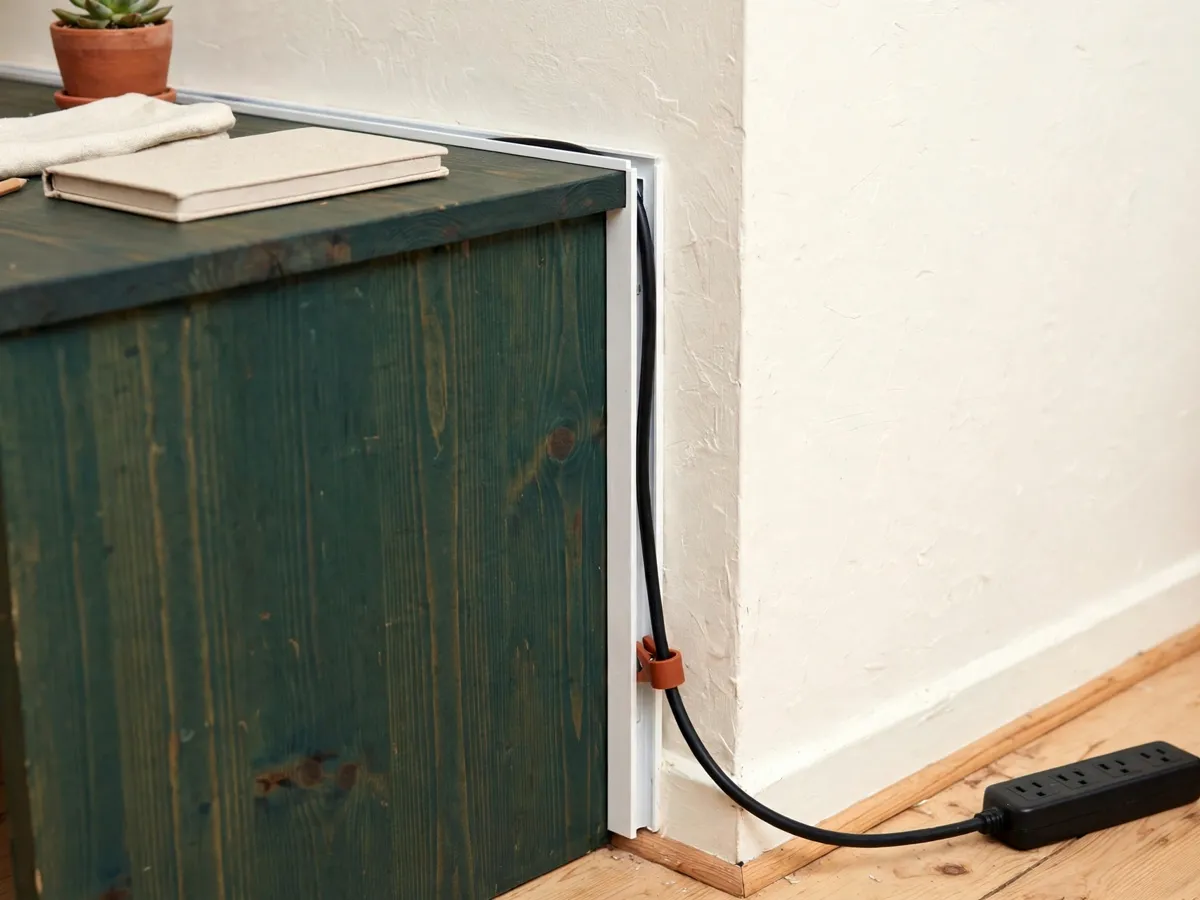
The cables are the difference between a work corner and a mess, and the fix is cheap. Run the power and the monitor cord in one line, not three. An adhesive raceway along the back edge of the desk hides the run, and a cable clip at the corner keeps it from swinging off when you pull the chair out. Everything that plugs in ends at one strip near the desk, so there is one tangle to manage, not one per cord.
Keep a spare outlet within reach. If the only socket is across the room, one grounded strip on the floor at the desk corner solves it — and a strip is a renter-safe swap, not a wiring job. The one thing to skip is drilling a new socket; that is landlord work and it is where a cheap office goes wrong.
Cost: $10–$25 for a raceway, a few clips and one strip. Time: 20 minutes.
Light and eye comfort for long sessions
A small office gets its light from one window and one lamp, so both jobs fall on them. Put the screen beside the window, not in it, and the daylight works the room while the screen stays out of glare. Add one warm task lamp at 2700K to the side of the screen so the room does not go to a single bright panel at night. Two soft sources beat one harsh one in a small room, for the same reason the hallway and bedroom plans do.
For the eyes, keep it simple and keep the light even. Match the panel to the room: adjust your screen brightness to match the level of light around you. A panel much brighter than the room reflects glare; much dimmer, it reads as a dark rectangle — matched to the light, neither happens.
For longer sessions, the American Academy of Ophthalmology eye-strain tips note that matching brightness and looking up regularly eases close-work fatigue, and reading counts as close work.
Cost: $8–$20 for a warm task lamp and a screen with adjustable brightness. Time: 15 minutes to set the light.
Make it look like yours — and fit the room it lives in
The footprint, the spot, the desk and the light are the working parts. The look is what makes the corner feel like your room and not a hotel business center — and you do not buy new furniture to get there. A few moves with color, one textile and a single object shift the whole corner, then you handle the room it sits in. These are the home office looks people search for under "small aesthetic" and "cozy style" — four directions, each built from the desk you already own.
Four looks that work with the desk you have
Warm minimal — linen and wood. Keep the palette to linen cream and natural wood, and let the desk surface show. One linen runner or desk pad under the keyboard softens the hard edge, and one ceramic cup or a single plant brings the texture. If the room is pale already, this look costs nothing — the desk and the wall do the work. Budget: $0–$40 for a pad and a cup you may already own.
Vintage desk — thrifted wood and brass. A thrifted wood desk or a hand-me-down table reads warmer than a white composite one, and the look wants brass-look hardware around it: a secondhand lamp, a pencil tin, a cup pull on a drawer. A scrap of worn leather or a small kilim piece under the mouse is the one textile. Budget: $0–$30 at a thrift run, less if the desk is already wood.
Dark and moody — a deep panel behind the monitor. A deep wall behind the screen makes the desk area feel deliberate rather than parked. For a renter, that is a fabric panel or a peel-and-stick sheet behind the monitor — not paint — and it takes the corner from leftover space to a defined spot. Pair it with a warm brass lamp and a dark cushion on the chair. Budget: $15–$60. The small bedroom accent wall guide covers the renter-safe materials for a deep panel.
Soft pink and warm neutral. A warm blush cushion, a cream placemat under the keyboard and one dried bouquet or a small ceramic pot — that is the whole look, and it sits well in a bedroom corner where the palette is already soft. Budget: $10–$30. The textile-and-texture layer is the same move that warms a reading corner, so the idea carries over from any cozy spot you have already styled.
Fit the room it lives in
No window — basement or interior wall. A room without a window has no daylight, so the lamp does two jobs: light the desk and light the room. Layer a desk lamp and a floor or shelf lamp at two heights, and place a mirror where it catches one of them — the bounce makes the corner read as lit, not boxed in. The mirror placement guide covers the angle that throws light rather than reflecting a blank wall.
Bedroom corner. The office shares the room with the bed, and the trick is separation, not a wall. Turn the desk so the chair faces away from the bed, or set a low open shelf between the desk and the bed as a divider — you see the room split into two zones without closing either one off. If the bedroom is the main room, the cozy bedroom ideas guide covers how to keep a shared bedroom reading calm with a work corner in it.
Living room or open plan. In a shared space, the desk goes against the back of the couch or along a side wall, and the rug edge marks the office zone — the desk sits behind the line, the seating in front. For two screens or two people, set the desks back to back along the couch spine so the screens face away from each other and neither chair blocks the walkway. The small living room layout guide covers the traffic paths so the desk does not eat the room.
Closet office. Take the doors off a reach-in closet and the alcove is a ready-made office — the desk spans the opening, one shelf above holds the monitor and the daily stack, and a strip light inside the frame handles the light. The depth is already right, and the walls are already there. The small closet organization guide covers the shelf heights and the door-off move.
Cost: $0–$60 for the look, depending on what you already own. Time: an afternoon to rearrange the textiles, the lamp and the mirror.
What we would skip
Skip the standing desk for a studio — it needs the floor the room does not have, and a riser on a normal desk gets most of the change for a fraction of the cost. Skip a full-sized desk, because the leftover wall is the limit, not the catalog. Skip a separate office rental, which is a whole different budget, and skip built-in shelving that needs a contractor, which turns a weekend office into a construction project. The one thing worth the money is the chair: you sit in it the most, and the secondhand task chair that fits the room beats the fancy one that does not.
Cost: $0. Time: the decisions that save the money.
Honest costs: where the money actually goes
Thrift route: secondhand task chair $30, a compact desk $40, a riser and two bins $30, a strip and raceway $20 — about $120 and one weekend, and the room stays walkable. New route: desk $120, task chair $80, riser and shelf $60, lamp and cables $35 — about $295. The two things that earn their keep are the chair and the cable run, because they are the daily touch points. Everything else can wait for a second pass.
Cost: $120–$295 for the whole corner. Time: one weekend, or two afternoons if the desk and the storage land on different days.
Weekend checklist: copy this before you start
- Wall measured and the footprint worked up: desk plus 30-inch pull-out plus a clear 30-inch path
- Spot chosen for light and quiet, screen out of direct sun
- Desk sized to the leftover wall, chair chosen for the pull-out it needs
- Screen on a riser at eye level, keyboard under it, one open folder on the surface
- Storage off the floor: one shelf on rated adhesive brackets, one open bin, one closed box
- Cables in one run on a raceway, ending at a single strip, one outlet within reach
- Screen brightness matched to the room, a warm 2700K lamp on the side, a timer to look up
Cost: $0 to check. Time: 15 minutes, before you open the shopping app.
Questions beginners ask
How much space does a real home office need?
Count the desk, the chair pull-out and the walkway, not just the desk. A compact 48 by 24 inch desk with a 30-inch pull-out and a clear 30-inch path needs roughly 60 to 84 inches of wall to floor. If you have less, go to a wall-mounted drop-leaf and a stool.
Can I put the desk against the window?
Yes, and usually you should, for the light — but keep the screen out of the direct sun so it does not glare. Put the monitor beside the window, not in front of it, and you get the daylight without the reflection.
Do I need a real office chair?
No. A stool or a good dining chair works for a studio and stores away when you stop working. The only hard need is room for the chair to pull out, so measure that first and buy the seat to fit it.
How do I keep the cables from looking like a mess?
One line, not one per cord. Run the power and monitor together in an adhesive raceway along the back of the desk, end it at a single strip near the corner, and keep a clip at the bend. Two touches do almost all of the job.
Save these on Pinterest
Pin the footprint math first, because it is the step that stops you buying a desk that does not fit. The warm-light half of a small work corner lives in the cozy living room ideas guide, and the no-drill shelf and bracket ratings are in the renter wall decor guide. Both sit in the Small Room Decor collection for the next corner you fit a room around.