 Plant As Deco
Small Room Decor Ideas
Reading Nook Ideas: 6 Cozy Corners for Small Spaces
By Plant As Deco · Updated 16 November 2026
You do not need a spare room for a reading nook — a reading nook corner bedroom setup needs about three feet square and one afternoon. Six steps build it in the order you will work: measure, claim the corner, use a chair you own, set the light at shoulder height, add one soft layer, and give the book somewhere to land. Nothing here is drilled, glued, or patched at move-out.
Weekend-ready: $20–$80, one afternoon. No drill, no mounting, renter-safe.
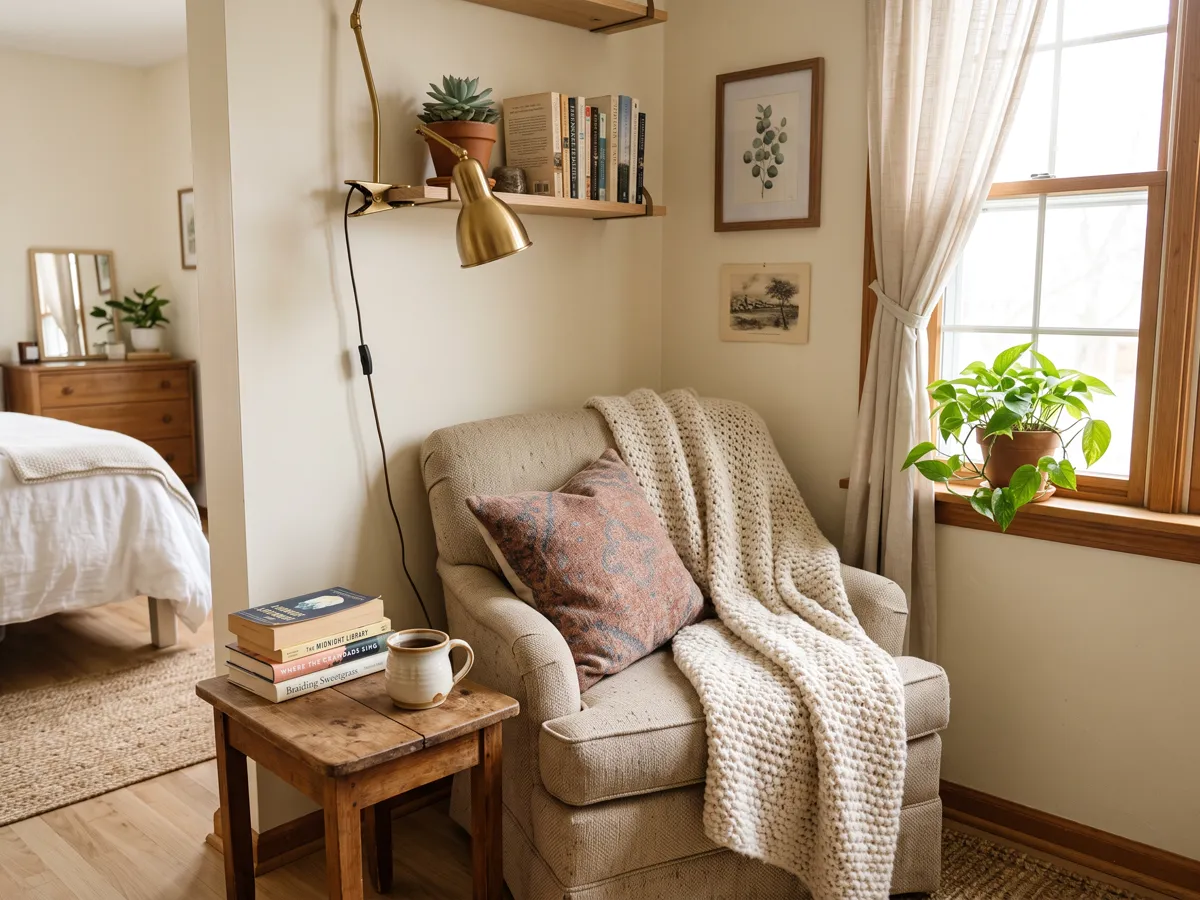
1. Measure the corner before you choose the chair
Seat width plus six inches of elbow room on each side is the real footprint of a reading chair — our working rule, not a standard. Measure the widest seat you own, add a foot, then measure the corner wall to the nearest door edge. A 30-inch chair wants about 42 inches of wall.
Then walk the door swing: the corner has to begin where the swing ends, or the chair gets pushed in every time someone walks in. The US Access Board guide to the ADA standards puts the minimum continuous clear width of an accessible route at 36 inches, reducing to 32 inches at points such as doorways. That is a public-building figure, not a rule for your bedroom.
Cost: $0. Time: 15 minutes with a tape measure. Write the numbers down, or you will measure twice.
2. Claim the corner closest to the window
Daylight is the best reading light and it costs nothing. Take the corner nearest the window — usually the one holding a laundry pile — and clear it completely. Three feet square fits a chair, a side table, and your feet. If that corner is taken, the one beside the bed works; the nook needs a boundary, not a view.
Cost: $0. Time: 30 minutes including the declutter. No chair? A floor cushion and a book stack still count.
3. Use the seat you already own
That reading nook aesthetic cozy look comes from the throw, not the chair price. Pull in the most comfortable seat you own — a secondhand armchair, a desk chair with a cushion, a floor cushion against the wall. Check three things: seat height that lets your feet rest flat, a back you can lean on, and arms wide enough to rest a book. Sit in it for ten minutes; a nook chair earns its corner only if you stay in it.
Cost: $0–$40 secondhand. Time: 20 minutes. Wobble test first — a creaky chair breaks the ritual.
4. Put the light at shoulder height, behind your reading shoulder
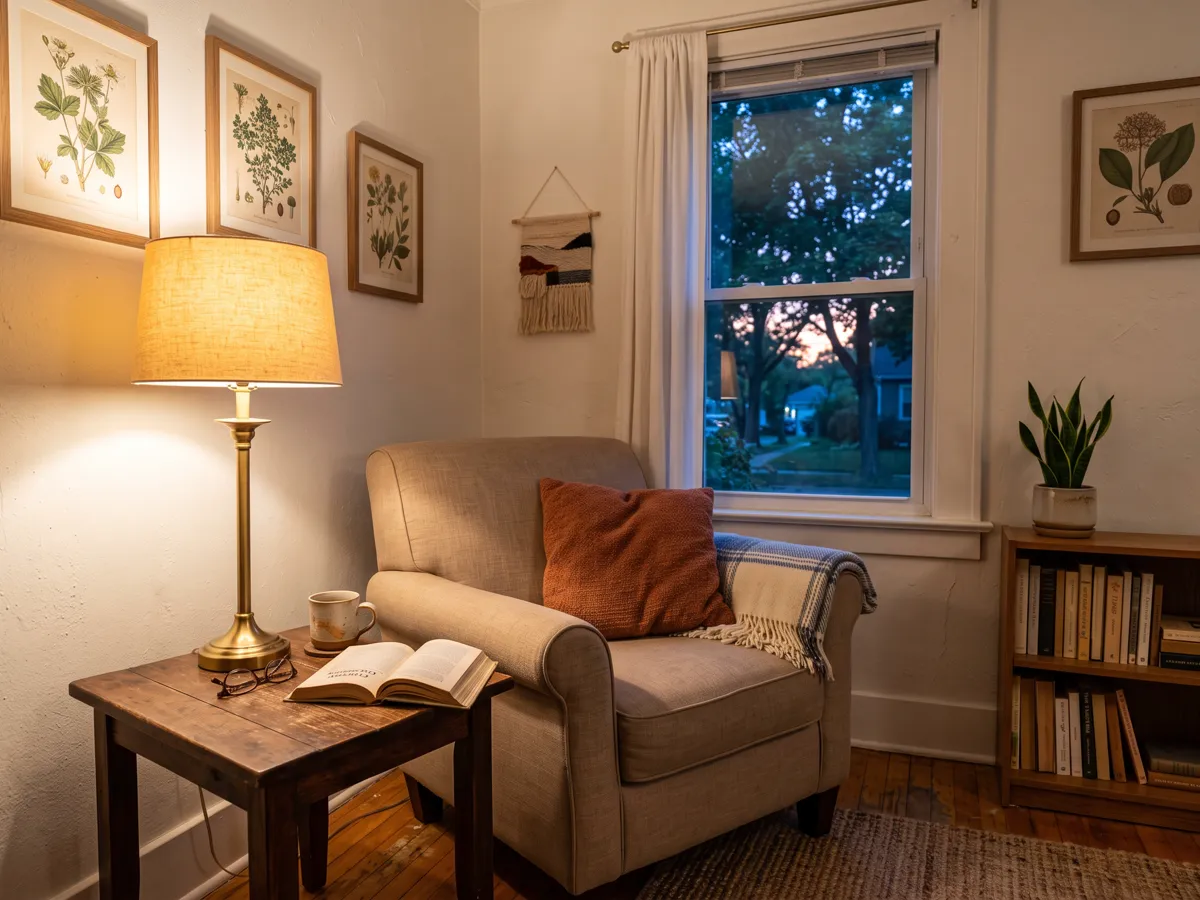
Overhead light glares on the page; a floor lamp at shoulder height, just behind your reading side, lights the book without lighting the room. The shade sits at your shoulder line while you are seated, so the pool of light falls on the page and your hands. A clip lamp on a shelf or headboard does the same job in less floor space.
Aim the shade down and keep the bulb warm — 2700K is our own choice, not a prescription. For bulb basics, the ENERGY STAR lighting guide explains warm color temperature in plain terms. For longer sessions, the American Academy of Ophthalmology eye-strain tips note that matching brightness and looking up regularly eases close-work fatigue, and reading counts as close work.
Cost: $12–$25. Time: 20 minutes. If you squint, the shade is too high or too far behind you.
When the light has to sit on the landing surface
Step 6 puts a small table within arm's reach, and that surface is the easiest place for the light to live: it brings the shade to shoulder height while you are seated without asking for floor space the chair already claims. A table lamp on that table is the version of this step that needs no floor lamp at all, which is the one to take when the nook is in a tight corner.
See the touch bedside table lamp. The included bulb is 3000K — warm white, close to the 2700K this guide picks for the room, and warm enough for the close-work rule above: shade aimed at the page, not at your eyes. Three brightness steps on a touch base means you can drop to the lowest setting for a wind-down read and leave it there. The two USB ports charge the e-reader that is the reason the light exists, so one fewer thing lives in the nook. Check the listed height against your seated eye line, and the base depth against the table from step 6, before you order.
Price and stock were checked when this guide was last updated; they move. As an Amazon Associate we earn from qualifying purchases.
5. Layer one throw and one cushion
Reading nook ideas for small spaces stay calm through texture: one knit throw over the chair arm, one linen cushion behind your back. Two layers are the whole formula. Skip the third cushion; small corners punish extras.
Cost: $15–$30. Time: 10 minutes. Wash both first so they feel broken in, not store stiff.
6. Give the book a landing spot
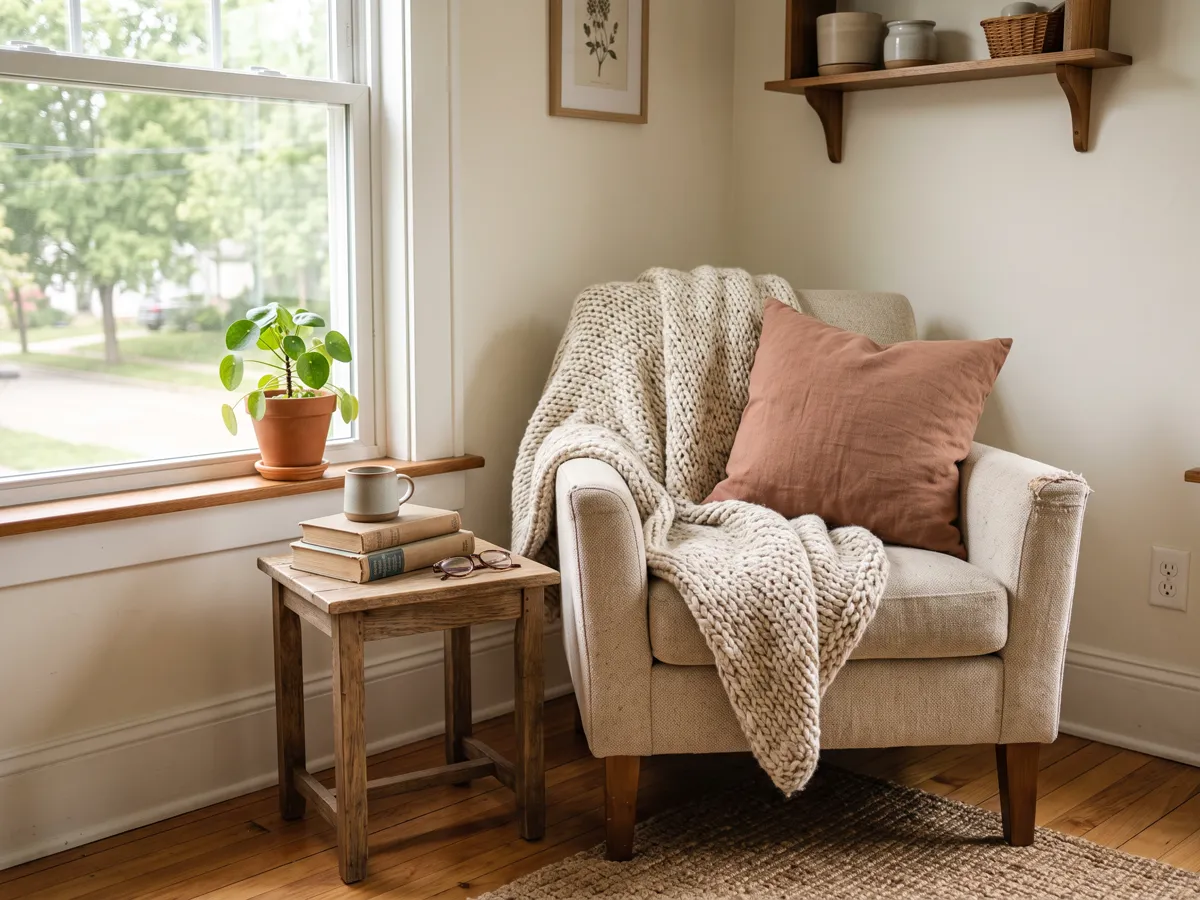
A nook without a side table becomes a lap-balancing act. Set a crate, stool, or small table within arm's reach — room for the current book, a mug, and nothing else. The top should sit near the chair arm so you can put a mug down without looking.
Cost: $0–$15. Time: 15 minutes. One mug, one book on top; the rest lives on the shelf.
Where the nook goes when the window corner is taken
Not every rental hands you a window. Three other spots hold a chair. The corner beside the bed takes a chair turned about 45 degrees to the wall, so its back becomes the boundary. A shallow closet holds a cushion and a lamp on a shelf with the door open. The gap between the sofa and the wall takes a floor cushion and a clip lamp. Measure each against the door swing first.
Cost: $0. Time: 10 minutes per spot. When two tie, take the one with a wall behind your back.
The three-item rule: seat, light, one surface
A reading corner holds three things — the seat, the light, and one surface for the book. Everything else is a guest. That is what stops the nook from becoming the chair you pile laundry on, and the way back is not an organizer: take out whatever is not one of the three. If the pile keeps returning, the surface is too big — swap the table for a stool.
Cost: $0. Time: 10 minutes. Count the items out loud — three is the answer.
The no-drill wall behind the nook
Once the chair is in, the wall behind it looks unfinished — and it is the one surface a renter cannot put a nail into. A leaning frame carries its own weight on the floor, so it asks nothing of the wall; its honest limits are the floor space it takes and the fact that a bumped chair can slide it. Adhesive strips are the other option, and the rating printed on the package is the only honest limit. That figure assumes a smooth, clean, fully cured wall; on texture or fresh paint, treat it as a ceiling rather than a promise. Start with one small frame and give it a month.
Where the frame sits matters as much as how it hangs. The Delaware Art Museum hangs two-dimensional works of art at a 58-inch center, so the middle of each piece sits at a general eye level. That is a museum figure, not a rule your room must obey.
Cost: $0–$25. Time: 20 minutes. Test one strip somewhere nobody looks first.
The five-minute nightly reset
The nook dies the day it becomes storage. Five minutes, same order, every night: book on the surface, mug carried out, throw folded over the arm, cushion squared, floor clear. Do it before you leave the room for the last time. If laundry lands there twice in a week, the rule needs repeating, not a bigger chair.
Cost: $0. Time: 5 minutes nightly. Pair it with something you already do.
Common questions
What are the best reading nook ideas for small spaces?
The ones that fit the corner you already have: measure the wall and the door swing, use a seat you own, put a floor lamp behind your reading shoulder, add one throw and one cushion, and give the book one surface. Three feet square, one afternoon, no drill.
How do you build a reading nook in a bedroom corner?
Clear the corner nearest the window and work in the order above: measure, seat, light, layers, surface. Turn the chair so its back faces the bed, and the corner reads as its own place.
How do you get the cozy reading nook aesthetic on a budget?
Texture and light, not furniture. One knit throw, one linen cushion, a warm bulb at shoulder height, ceiling light off after dark. Wash the textiles first so they drape, and stop at two layers.
Does a reading nook corner have to be by a window?
No. A window corner gives the best free light, but the nook needs a boundary more than a view. The corner beside the bed, a shallow closet with the door open, or the gap behind the sofa all work if the door swing stays clear.
Which chair works for a reading nook corner?
The one you can sit in for ten minutes without shifting. Feet flat, a back you can lean on, arms that take a book. Measure the wall before you buy.
Afternoon checklist: copy this before you start
- Corner measured: seat width plus elbow room, door swing marked
- Window corner claimed and fully cleared
- Seat moved in and sit-tested for ten minutes
- Floor lamp set at shoulder height behind the reading side
- Throw and cushion layered, both washed
- One surface within arm's reach of the chair
- Wall decided: leaning frame or rated adhesive strip
- Three-item rule agreed, five-minute reset timed once
Before and after: what actually changes
Before: a dead corner holding a laundry pile, reading in bed under a ceiling bulb, books stacked on the floor. After: a measured three-foot corner with a sit-tested seat, a warm lamp at shoulder height, one throw and one cushion, one surface for the book, and a five-minute reset that keeps it. Same room, same rental, same afternoon. The difference is a boundary, not square footage.
Skip the showroom moves: a matching chair-and-ottoman set, built-in shelves you cannot mount, or a full bookcase for a corner that holds ten books.
Save these on Pinterest
Saving this checklist beats memorizing it. Pin the setup you will build this afternoon, then come back when the corner is done — the Small Room Decor collection holds the rest of the room-by-room ideas.